ITR Filing Documents for Company and LLP: Checklist
ITR filing documents for a company or LLP: the PAN, digital signature, bank, audit and e-verification items to keep ready before you file on the portal.
Updated: 24 October 2026
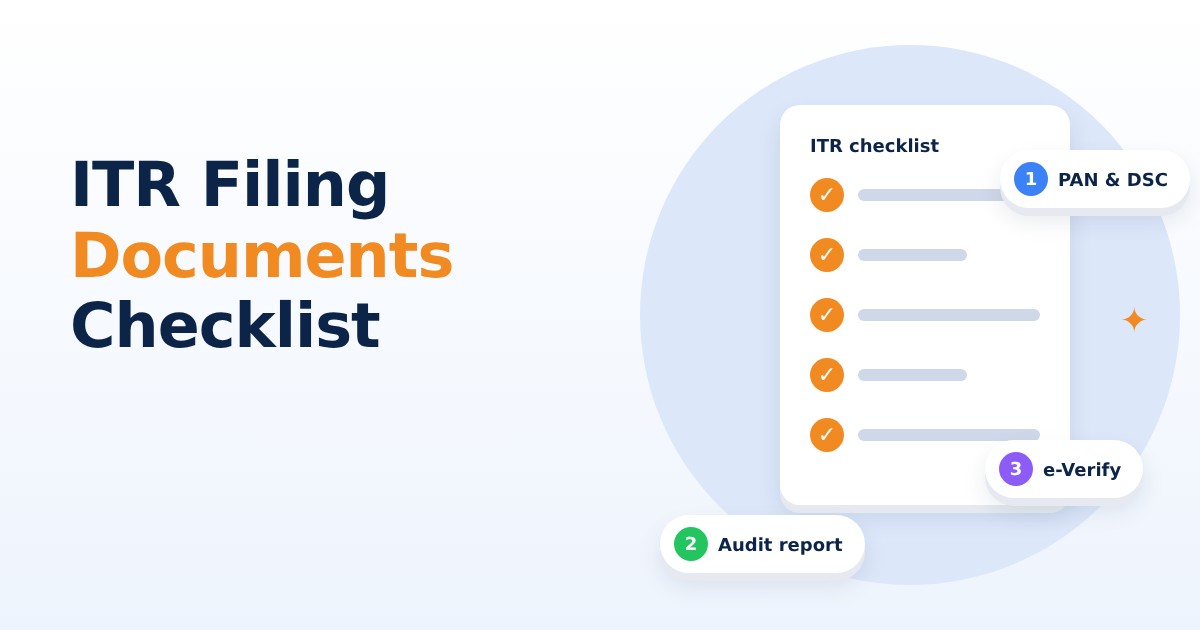
The ITR filing documents for a company or LLP are mostly set-up items rather than paper: an active PAN, a valid digital signature, a pre-validated bank account, a linked mobile number and, where applicable, an audit report. If any of these is missing, the return can get stuck on the income tax e-filing portal even when your accounts are ready.
This is an evergreen checklist built from the Income Tax Department's own help pages, not a news update. The pages we read refer to AY 2023-24 in places, and forms and rules change every year, so confirm the current form instructions on the portal or with your Chartered Accountant before you file.
Which return form does a company or LLP file?
According to the department's ITR-5 and ITR-6 tutorial, ITR-5 is for firms and Limited Liability Partnerships (LLPs), along with categories such as AOPs and BOIs. ITR-6 is the return for companies.
Knowing the form matters because the extra statutory forms, and the schedules inside the return, depend on it. Your CA or accounting team should confirm the form before anyone starts collecting documents.
What do you need ready before filing on the portal?
The tutorial lists the same prerequisites for both ITR-5 and ITR-6. Treat them as the core of your ITR filing documents checklist.
- Registered user with an active PAN: the entity must be registered on the e-filing portal and its PAN must be active.
- Updated login profile: key person details need to be added in the profile before filing.
- Digital signature: the digital signature must be updated in the login profile before you file.
- Pre-validated bank account: the account is nominated for refund and should be pre-validated.
- Valid mobile number: it should be linked to the e-filing portal, Aadhaar, bank or depository.
- Applicable statutory forms: any statutory form the return depends on must be filed first.
Which statutory forms must be filed before the return?
The tutorial says an ITR-5 filer who wants to opt into the new tax regime files Form 10IF once, within the due date under section 139(1). For ITR-6, Form 10IB, 10IC or 10ID is filed within the same due date, depending on whether the company is under section 115BA, 115BAA or 115BAB.
If you are not sure which of these applies to your company, ask your CA early. These forms are filed before the return, so leaving them to the last day is risky.
What is needed to register a company on the e-filing portal?
If your company is not yet registered, the department's company registration FAQs say you need a valid, active company PAN and a registered digital signature certificate (DSC) of the Principal Contact. The Principal Contact's own PAN must also be registered on the portal.
The Principal Contact is the company's main representative, with signing authority and the power to bind the company, and receives the department's communications, including notices and orders. Choose someone who will actually check the portal.
One practical warning from the same FAQs: a DSC issued with a default PAN is not accepted by the portal. If you see a PAN mismatch error, use a DSC without PAN encryption.
Do you need an audit report before you file?
The tutorial mentions the audit report in Form 3CD, for example where amounts disallowable under section 37 have to be reported in an ITR-6. Whether your entity needs an audit at all depends on your own facts, so your CA should decide that.
For AY 2026-27, a CBDT press release dated 28 September 2026 changed dates for persons subject to audit. The return due date moved from 31 October 2026 to 21 November 2026, and the audit report date from 30 September 2026 to 21 October 2026. The release applies to a specific category, so check whether it covers you.
- Ask your CA whether an audit report is needed this year and when it will be ready.
- Keep the signed financial statements and audit report in one folder, so the schedules are filled from final numbers.
How do you e-verify the return?
Filing is not complete until the return is verified. The portal's e-verification page lists five modes: Digital Signature Certificate, Aadhaar OTP, Electronic Verification Code using a bank or demat account, Electronic Verification Code through a bank ATM (offline), and Net Banking.
The page states that the time limit for e-verification or ITR-V submission is 30 days from the date of filing. Note that the page gives no separate guidance for companies or firms, so ask your CA which mode suits your authorised signatory. For a DSC, the page says you need a valid, active Class 2 or Class 3 certificate and the emsigner utility running on your PC.
A simple pre-filing checklist
Before the due date is near, go through this list and fix the gaps while there is still time.
- Active PAN of the entity, and PAN of the Principal Contact registered on the portal.
- DSC valid, not expired, and updated in the login profile.
- Key person details updated and mobile number linked.
- Bank account pre-validated for refunds.
- Form 10IF, 10IB, 10IC or 10ID filed if your case needs it.
- Final financial statements and, if applicable, the audit report ready.
- A decided e-verification method and a person who will do it.
Most filing delays for companies and LLPs come from set-up items like an expired DSC or a missing profile update, not from the accounts. Check these items weeks before the due date, and confirm the latest rules on the Income Tax portal or with your CA, because forms and dates change.
Frequently asked questions
What documents are needed to file ITR for a company?
The portal prerequisites are an active PAN, a registered user profile with key person details, a digital signature updated in the profile, a pre-validated bank account and a linked mobile number. Where applicable, you also need the audit report in Form 3CD and any statutory form filed first.
Which ITR form does an LLP file?
According to the department's ITR-5 and ITR-6 tutorial, ITR-5 is for firms and LLPs, while ITR-6 is for companies.
Is a digital signature compulsory to register a company on the e-filing portal?
The company registration FAQs say a registered DSC of the Principal Contact is required, along with a valid, active company PAN. A DSC issued with a default PAN is not accepted.
How long do I have to e-verify my ITR?
The e-verification page cites a time limit of 30 days from the date of filing the return. Check the portal for the current rule before you file.
Sources
- Webinar on filing ITR 5 & 6 (Income Tax portal tutorial) (incometax.gov.in)
- Register for e-Filing (Company) FAQs (Income Tax portal) (incometax.gov.in)
- How to e-Verify User Manual (Income Tax portal) (incometax.gov.in)
- CBDT extends due date for furnishing Return of Income for AY 2026-27 (press release) (incometaxindia.gov.in)
This article is general information based on the sources above, as of 24 October 2026. It is not tax or legal advice. Tax rules and due dates change, so confirm with the official Income Tax Department website or a Chartered Accountant before you act.
Need help turning this into results for your business? Talk to the Knight21 team or see our software, AI and digital marketing services.