Proprietorship, Partnership, LLP or Pvt Ltd: Pick the Right Structure
Compare proprietorship, partnership, LLP and private limited company on liability, compliance, funding and credibility, so you meet your CA knowing what to ask.
You have a working idea and maybe a few customers already. It could be a clinic in Rajahmundry, a tiffin centre turning into a cloud kitchen in Vijayawada, a real estate consultancy in Hyderabad or a small software team in Kakinada. Then someone asks for your GST number, a bank asks for registration documents, or a bigger client wants an invoice from a "proper company", and you realise you need to decide what kind of business you actually are.
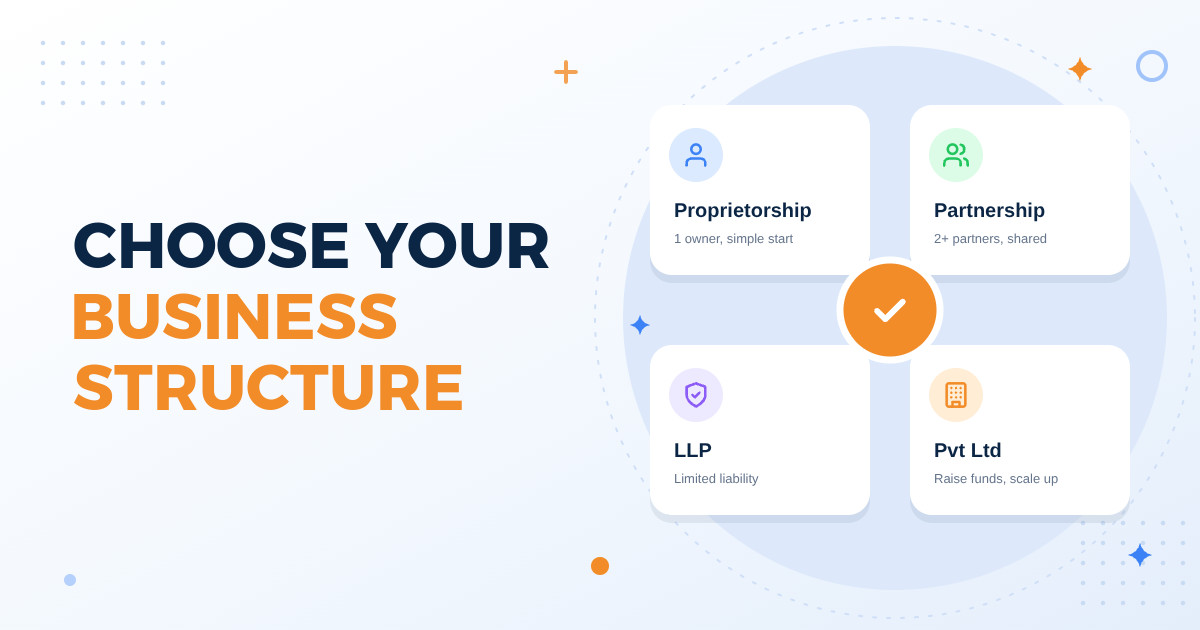
Proprietorship, partnership, LLP and private limited company are the common choices, and advice from friends and relatives often contradicts itself. This guide compares them on personal liability, compliance effort, raising money and credibility, so you meet your chartered accountant or company secretary knowing what to ask.
The four options in plain words
Rules and procedures change from time to time, so treat this as a map, not legal advice. Other forms exist, such as a one person company; ask your adviser if none of these fit.
- Sole proprietorship: you and the business are the same person in the eyes of the law. It is the quickest to start and usually rests on registrations like GST or a local shop licence rather than a separate incorporation.
- Partnership firm: two or more people run a business together under a partnership deed that sets out capital, profit sharing and roles. The firm and the partners are not fully separate.
- Limited Liability Partnership (LLP): a registered entity separate from its partners, run according to an LLP agreement. It combines partnership-style flexibility with limited liability.
- Private limited company: a separate legal entity owned by shareholders and managed by directors. It has the most formal structure and the most paperwork, and it is the form most professional investors are used to.
Liability: what happens to your house if things go wrong
This question is easy to skip, and it matters most. In a proprietorship, business debts are your personal debts. If a supplier goes unpaid or a loan goes bad, your savings, vehicle or property can be at risk. In a typical partnership it can be worse, because you may be held responsible for obligations your partner created, even ones you did not know about.
In an LLP or a private limited company, the business is a separate legal person, so your risk is generally limited to what you put in. This protection is not absolute. Personal guarantees you sign for bank loans, fraud and certain statutory dues can still reach you personally. Still, if your business takes on large contracts, buys stock on credit, signs long leases or handles customer advances, as many construction, real estate and trading firms do, limited liability deserves serious thought.
- How much could the business owe at its worst moment, compared with what you personally own?
- Will you sign long contracts, leases or supplier credit lines?
- Will you work with a partner whose decisions could bind you?
Compliance effort: be honest about your bandwidth
Every structure needs some compliance, such as income tax filings and GST returns if you are registered. Beyond that, the effort rises roughly in this order: proprietorship, partnership, LLP, private limited company. An LLP typically has regular annual filings with the government registry. A private limited company usually adds board meetings, an audit, statutory registers and more formal record keeping.
None of this is impossible, but it costs time and professional fees every year, whatever the business earns. A home baker or a single-doctor clinic may find company compliance heavy in the early years. A business that already keeps clean books in accounting software will feel it much less. Missed filings can attract penalties that grow the longer they are left, so choose a structure you will genuinely keep up with.
- Ask your CA for an approximate yearly compliance cost for each option, including audit and filing support.
- Decide who in your team will own deadlines, documents and reminders.
- Look at how your billing and accounts are kept today, because organised digital records make every structure easier.
Raising money: who will fund your growth?
If you plan to grow with your own profits and the occasional bank loan, a proprietorship or partnership may serve you well for a long time. Banks can lend to any of these structures, though they look closely at your track record, books and collateral.
If you hope to bring in angel investors, venture funds or even a relative as a part-owner, a private limited company is usually the expected format. Investors typically buy shares, which a company can issue, and a company can also offer employee stock options to keep key people. LLPs bring in money through partner contributions, which many investors find less convenient. A useful test: if there is a real chance you will pitch to investors in the next few years, discuss starting as a company, or at least the path to converting later.
Credibility with clients, banks and partners
Perception matters in Indian business. Some larger corporate clients and some tenders prefer or require vendors to be a registered LLP or company, so check what your target clients ask for. "LLP" or "Private Limited" in your name can make a first meeting easier and signals that the business exists independently of one person.
That said, credibility comes far more from how you work: on-time delivery, clean GST invoices, a proper website, a professional email address and good reviews. A well-run proprietorship with these in place often looks more trustworthy than a company with an unanswered WhatsApp number and no online presence. If your customers are local walk-ins, as with a restaurant, a kirana store or a salon, structure rarely affects whether they buy from you.
A simple way to decide, and mistakes to avoid
Write down your answers to four questions. How much personal risk can you accept? How much time and money can you spend on compliance each year? Will you need outside investors? Do your target clients insist on a particular form? Take this sheet to a qualified chartered accountant, company secretary or lawyer, and ask them to compare tax treatment, compliance and conversion options using your own expected revenue and profit.
- Choosing only by setup cost. The yearly cost of staying compliant matters more over time.
- Starting a partnership without a written deed. Verbal understandings between friends or relatives cause some of the most painful disputes.
- Copying a friend's structure. Their risk, plans and industry may be completely different from yours.
- Ignoring exits and succession. Think about what happens if a partner leaves or you later want to sell the business.
- Assuming you can never change. Converting between structures is often possible, but it takes paperwork and planning, so ask about it upfront.
- Forgetting your brand. Registering a business name is not the same as protecting it as a trademark, so ask about both.
There is no single right answer. A proprietorship can be perfect for a small local shop, an LLP can suit professionals working together, and a private limited company often makes sense for a business that wants to scale or raise funds. Choose based on your risk, bandwidth and plans, confirm the details with a qualified professional, and revisit the decision as your business grows.
Once your structure is settled, the next job is making the business easy to find and easy to work with. Knight21, based in Kakinada, builds websites, apps, custom software and automation for growing businesses, and also offers help with GST registration, trademark registration and compliance for online businesses. If you would like to talk through your next step, reach out at knight21.in/contact.