Performance Marketing vs Digital Marketing 2026
Confused between performance and digital marketing? Breaking down the real difference, no jargon, so you know where to actually spend in 2026.
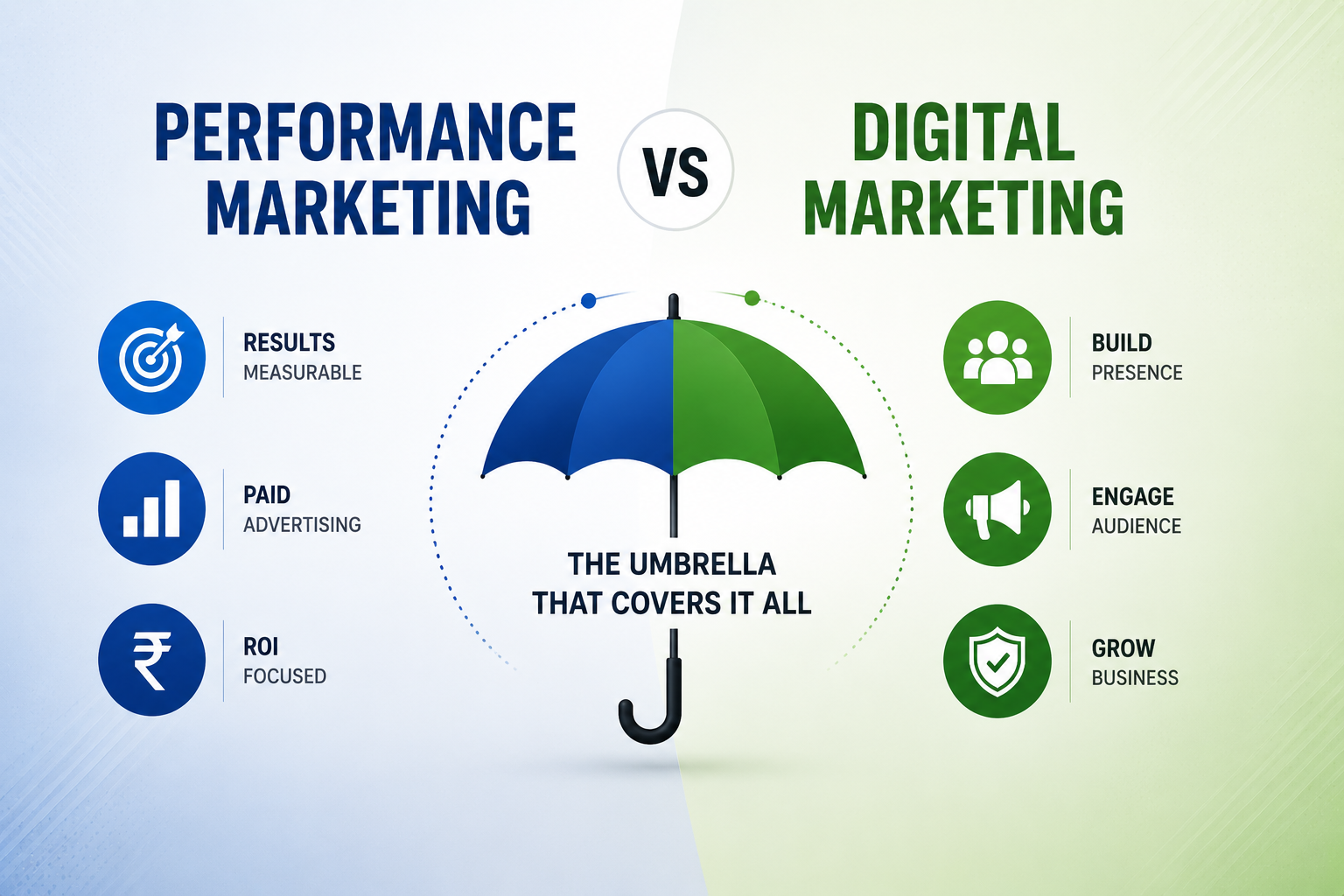

Performance Marketing vs Digital Marketing: What's the Real Difference in 2026?
Had this exact conversation with a client last Tuesday. He kept using "performance marketing" and "digital marketing" like they meant the same thing, and honestly, most people do. But they're not the same, not even close.
If you're the one deciding where your marketing budget goes, mixing them up can actually hurt you.
The quickest way to explain it is this: digital marketing is the whole umbrella. Performance marketing is a results-focused part of that umbrella, with a strong focus on tracking clicks, leads, conversions, purchases, and other measurable outcomes.
That's the short answer. Now let's get into the more useful one.
What Falls Under Digital Marketing?
Pretty much everything, if I'm being honest. SEO, Instagram, email marketing, YouTube, blog posts, podcasts, websites, online advertising and more can all fall under digital marketing.
The thing people forget is that not every digital marketing activity is designed to generate an immediate sale. Some activities are about staying visible, building trust, developing an audience and becoming the brand someone remembers when they finally need what you sell.
You can't always draw a clean line from "posted this" to "made this sale." That doesn't mean the marketing isn't doing anything.
In fact, digital marketing covers a wide range of online channels and assets, including websites, social media, email and online advertising.
Where Performance Marketing Comes In
Performance marketing is much more focused on measurable outcomes.
It lives and dies by tracking numbers such as clicks, cost per lead, conversion rate, purchases, customer acquisition cost and ROI.
Google Ads, Meta advertising, affiliate marketing and other measurable paid campaigns can be used as part of a performance marketing strategy.
The basic idea is simple: every rupee should have a measurable job.
For example, Google Ads conversion tracking can help businesses measure actions such as purchases, sign-ups and phone calls, making it easier to understand which campaigns are producing valuable customer actions.
Learn more about Google Ads conversion measurement .
Performance Marketing vs Digital Marketing: Where Do They Split?
1. Measurability
Performance marketing puts a strong emphasis on measurable actions such as clicks, leads and conversions. Digital marketing is broader and can also include goals such as brand awareness, visibility, audience building and engagement.
2. How You Pay
Digital marketing can involve different payment models, including content retainers, advertising budgets, software costs and agency fees.
Performance marketing is generally built around measurable performance goals and outcomes. Depending on the campaign, payment may be connected to clicks, leads, sales, commissions or other agreed performance actions.
3. Timeline
Digital marketing often plays the long game. SEO, content marketing and audience building can take time to create meaningful results.
Performance marketing can start producing measurable campaign data much sooner because paid campaigns can generate traffic and conversions soon after launch.
4. Where the Money Goes
Digital marketing can include both paid and organic channels. Performance marketing is commonly associated with paid, measurable campaigns and result-oriented partnerships.
5. Risk and Measurement
Performance marketing can give businesses greater visibility into where their advertising budget is going because campaign performance can be tracked using metrics such as conversions, cost per acquisition and return on ad spend.
Other digital marketing activities may require more patience because their value can build over a longer period.
So What Should You Actually Focus On?
Most businesses need both. It's really a balance question, not an either-or decision.
If your business has a tight budget and needs leads or sales quickly, performance marketing can be a practical starting point because you can launch campaigns and measure the results.
Once things become more stable, adding SEO, content marketing, social media and other digital marketing activities can help build an audience and organic visibility.
That means you're not permanently dependent on paying for every single visitor.
Heading into 2026, this balance matters even more. Advertising platforms are increasingly using automation and AI-powered systems for bidding, targeting and campaign optimisation.
At the same time, businesses still need useful content, strong websites, brand trust and a genuine online presence.
The businesses that do well aren't necessarily picking one. They're using performance marketing for today's measurable revenue while building digital marketing assets for tomorrow's growth.
Performance Marketing vs Digital Marketing: Which Is Better?
There isn't one universal winner.
If the main goal is immediate leads, sales or measurable campaign results, performance marketing can be the better starting point.
If the goal is long-term visibility, organic traffic, brand awareness and customer trust, broader digital marketing becomes extremely important.
For many businesses, the strongest approach is to combine both.
Conclusion
These two aren't really rivals, no matter how the conversation usually goes.
Digital marketing builds the foundation: your reputation, visibility, content, audience and the reason people trust you before they even talk to you.
Performance marketing takes a more direct approach to measurable business outcomes such as leads, sales and conversions.
Lean too far into just one and you can create a problem. You may either spend continuously on paid traffic without building lasting assets, or build slowly without enough short-term revenue to support the business.
The smarter approach in 2026 is to understand what each strategy does well and use both where they make sense.
Frequently Asked Questions
Is performance marketing a type of digital marketing?
Yes. Performance marketing is generally considered a results-focused part of digital marketing. It concentrates on measurable actions such as clicks, leads, conversions, purchases or other defined business outcomes.
Which gets results faster?
Performance marketing can generate measurable results faster because paid campaigns can start driving traffic and conversions soon after launch.
Digital marketing activities such as SEO and content marketing usually need more time to build visibility and organic traffic.
Google notes that SEO changes can take anything from hours to several months to show an impact in search results, depending on the change and circumstances.
Read the Google SEO Starter Guide for more information.
Can I just skip digital marketing and only run ads?
You can rely heavily on paid advertising for a period of time, especially when you need immediate traffic or leads.
But building organic visibility, useful content, brand trust and an audience can help reduce long-term dependence on paid traffic.
Does SEO count as performance marketing?
SEO is generally classified as digital marketing. You can measure SEO through rankings, organic traffic, leads and conversions, but SEO itself is different from running a paid performance advertising campaign.
For SEO best practices, see Google's SEO Starter Guide .
What budget split makes sense right now?
There is no universal budget split. A business should consider its industry, goals, customer journey, competition, cash flow and existing organic presence before deciding how much to invest in performance marketing and other digital marketing activities.
Instead of following a fixed 60–70% rule, start with your business objectives and adjust the budget according to actual campaign performance.
Useful Digital Marketing Resources
- Google Ads Conversion Measurement
- Google Search Central SEO Starter Guide
- HubSpot Digital Marketing Guide
- HubSpot Performance Marketing Guide